That question reframes a familiar choice for US DeFi power users: convenience versus control, or more precisely, convenience that preserves enough transparency to avoid “blind signing.” Rabby Wallet’s central claim — simulate transactions before you sign them — is not a cosmetic safety feature. It changes the decision boundary between a user who guesses what a smart contract will do and a user who can inspect a near-exact preview of token flows and fees. But as with every security design, the mechanism brings trade-offs, gaps, and predictable failure modes you should understand before subjecting large balances to it.
This commentary walks through how Rabby’s transaction-simulation model works in technical and operational terms, what it meaningfully prevents (and what it doesn’t), how that fits into multi-chain workflows in the US DeFi ecosystem, and practical heuristics for when to rely on simulation versus when to add layers such as hardware wallets or multi-sigs.
Mechanism: what transaction simulation actually does
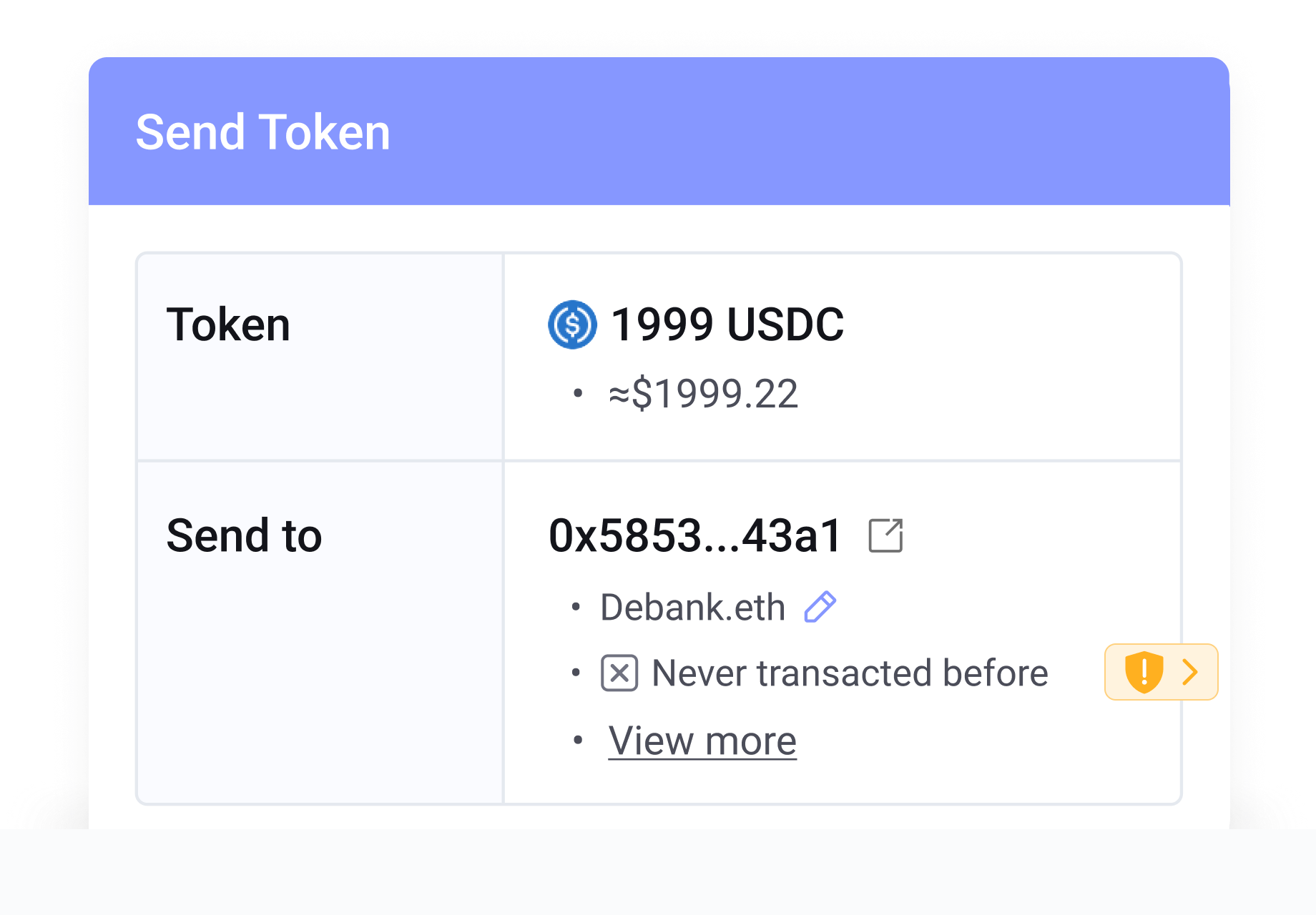
“Simulation” here means the wallet constructs the same call data a dApp would send, executes that call against a local or remote node in read-only mode (a state simulation), and returns the expected effects: token balance changes, fee estimate, and contract calls that would occur if the transaction were mined. Rabby surfaces that information to the user before signing so the user can compare expected outputs against intent. This is different from signature heuristics or rule-based blocking: it is a dynamic, state-aware preview.
Why that matters: many DeFi losses come from blind approvals or transactions that execute an unexpected swap path, drain, or approval. If a simulation reveals an unexpected outgoing transfer or a large approval to an unfamiliar contract, you can cancel the action before exposing your private keys. In practice Rabby couples this with a pre-transaction risk scanner that flags known hacked contracts, suspicious approval patterns, and non-existent recipient addresses — combining pattern recognition with deterministic state inspection.
What simulation prevents — and what it can’t
Simulation is powerful in preventing mis-signed operations that would immediately change balances: unintended token transfers, approving infinite allowances, or confirming a swap via a malicious router. It also helps estimate gas and cross-chain needs by showing fee costs and allowing Cross-Chain Gas Top-Up in workflows where you need ETH or BNB on another network to proceed.
However, simulation has explicit limits. It cannot protect against supply-side vulnerabilities in the smart contract itself—if a legitimate transaction triggers a vulnerable contract logic path that only manifests on-chain (for example, an oracle-manipulation exploit triggered by external price feeds), a local simulation that uses cached or current state may not predict future on-chain state changes caused by external actors. Similarly, simulation assumes the node and state used for the preview are accurate and timely; front-running, MEV reordering, or mempool manipulations can cause the post-mined outcome to differ. In short: simulation reduces the risk of blind-sign errors, but it is not an oracle for future-chain behavior or a substitute for contract-level audits.
Rabby’s broader security architecture and practical consequences
Rabby’s design bundles several security affordances that make the wallet appealing for advanced DeFi users: open-source MIT-licensed code that permits external audits; a built-in approval revocation tool to prune dangerous allowances after interactions; hardware wallet integration (Ledger, Trezor, Keystone and more); and automatic network switching to reduce user error when interacting with multi-chain dApps. For US users juggling transactions across Ethereum, Arbitrum, Optimism, and BNB Chain, automatic network switching and the ability to top up gas across chains simplify flows that would otherwise cost time and increase manual risk.
Yet trade-offs remain. Rabby lacks a native fiat on-ramp and in-wallet staking, so it does not replace custodial or exchange-based entry points for users who want to buy crypto directly with USD. The absence of in-wallet staking means long-term yield strategies still require destination platforms or separate stake-enabled wallets. And past incidents matter: the 2022 Rabby Swap contract exploit, while followed by a response that included contract freezing and compensation, is a concrete reminder that development teams can make mistakes and that technical mitigations (simulations, revocation tools) are necessary but not sufficient defenses.
Comparative perspective: where Rabby sits among alternatives
MetaMask, Trust Wallet, and Coinbase Wallet are prominent alternatives, but Rabby differentiates itself by attempting to operationalize pre-sign safety. MetaMask has expanded protection and plugins; Rabby’s distinguishing features are the pre-transaction simulation and the Flip toggle that lets users switch default behavior between Rabby and MetaMask. For institutional or high-value retail users, Rabby’s integrations with Gnosis Safe and custody solutions like Fireblocks make it viable in mixed custody or multi-sig workflows where simulation becomes an auditable step in internal approval processes.
Still, the value of simulation is context-dependent. If your organization uses time-delayed multisig approvals and a strict on-chain policy, a simulation is an additional check but not a primary control. For a solo DeFi trader interacting with novel liquidity pools and composable strategies, simulation will often be the most immediately useful defense against accidental drains and infinite approvals.
Decision heuristics for DeFi power users
Here are re-usable heuristics to decide when Rabby’s simulation model meaningfully helps you and when you need additional controls:
- If you’re performing routine swaps on audited, top-tier DEXs, simulation reduces cognitive friction by showing exact balance deltas and gas. Use it as a confirmation layer rather than the sole guard.
- If you interact with new contracts, tokens, or permissioned routers, treat simulation as a binary filter: if it highlights unexpected outflows or large approvals, decline and investigate using a block explorer or contract source.
- When large-value transfers are involved, require hardware wallet signing even with simulation visible; the hardware device preserves a more robust chain of custody for private keys.
- For institutional flows, incorporate simulation outputs into pre-approval documentation for multisig signers; the deterministic preview serves as an auditable artifact of intent.
These heuristics reflect the wallet’s strengths — clear, state-based previews, approval revocation, and cross-chain convenience — while recognizing that simulations cannot replace defense-in-depth.
What to watch next
Signals that would change how much you should rely on Rabby’s simulation include: improvements in mempool transparency or MEV protection (which would reduce divergence between simulated and mined outcomes), adoption of standardized on-chain proofs of simulation by wallets, or the addition of fiat on-ramps and native staking that would make Rabby a broader entry and yield platform. Conversely, repeat contract-level incidents or supply-chain compromises in the wallet’s dependencies would be a reason to downgrade trust until those vectors are addressed.
Because Rabby is open-source, community and third-party audits matter; watch audit cadence and independent reviews to evaluate whether simulation tooling is being matched by secure development practices. The wallet’s 2022 exploit and subsequent remediation show the team has operational experience handling incidents — an important signal, but not a substitute for continuous verification.
Where to download and try the wallet
If you want to test the workflow in a low-risk way, install the Rabby browser extension and use it on testnets or with small balances to observe how transaction simulations present balance deltas and approvals. The official extension can be found via this link for installation and first-run guidance: rabby wallet extension. Pair it with a hardware wallet for signing, and practice revoking approvals after token interactions to internalize the toolset.
FAQ
Does transaction simulation make blind signing impossible?
No. Simulation reduces the likelihood of blind signing by revealing expected token and fee changes, but it does not make blind signing impossible. It cannot predict future external state changes, mempool reordering, or exploits in the contract’s logic that depend on off-chain inputs. Simulation is a powerful mitigation, not an absolute guarantee.
Can I use Rabby with hardware wallets and multisig setups?
Yes. Rabby integrates with major hardware wallets (Ledger, Trezor, Keystone, and others) and supports institutional workflows via integrations with Gnosis Safe, Fireblocks, and similar custody solutions. For high-value operations, combine simulation with hardware signing and multi-sig approvals for defense-in-depth.
Will Rabby replace my exchange wallet for buying crypto with USD?
Not currently. Rabby lacks a built-in fiat on-ramp, so US users who want to purchase crypto with USD will still use exchanges or third-party on-ramps to fund an address. Rabby is focused on secure, multi-chain DeFi interactions rather than fiat onboarding.
How should I use the approval revocation tool?
Use revocation as standard hygiene: after authorizing a contract for trading or liquidity provision, check active allowances and immediately revoke ones you no longer need. Pair revocation with simulation when re-authorizing: simulate the intended transaction to confirm the contract behaves as expected before granting a new allowance.
Final practical takeaway: for US DeFi power users, Rabby’s transaction simulation reframes signing from a leap of faith into an inspectable act. Use it to catch the low-hanging errors and reduce routine exposure, but treat it as one layer in a broader risk-management stack that includes hardware signing, approval hygiene, and prudent limits on where and how much you trade or supply. The simulation changes the odds; it does not remove the need for judgment.
Recent Comments